
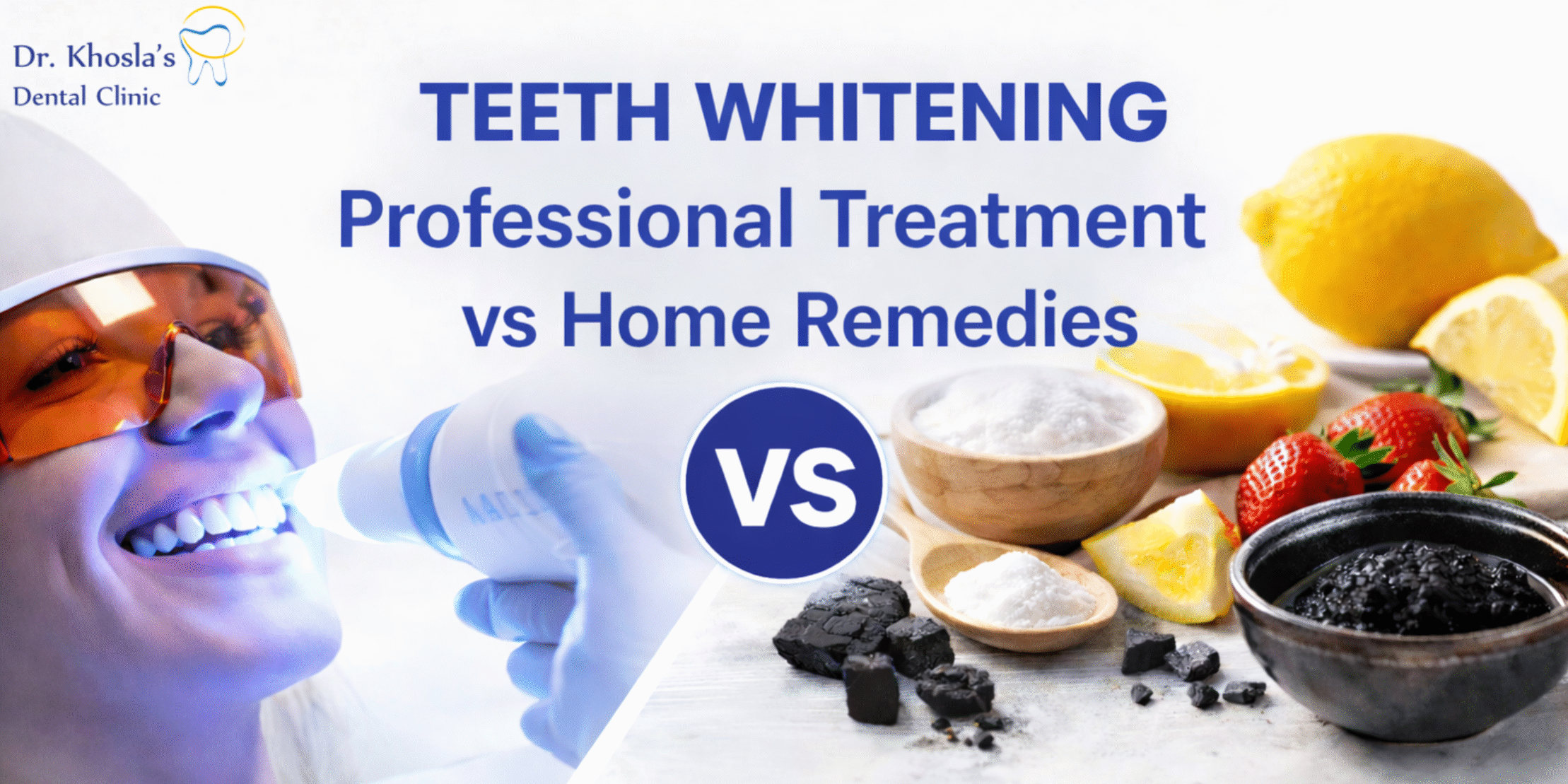
The moment you step into a room, your bright and confident smile is usually one of the first things people notice. However, over time, even healthy teeth can lose their whiteness due to coffee, red wine, smoking, ageing, and certain medications.
So, when it comes to teeth whitening, most patients are often stuck between choices: “Should I opt for professional treatment or stick to the home remedies?”
Stuck in a similar situation? This guide from Dr. Khosla’s Dental Clinic will explore all about teeth whitening so you can make an informed decision based on science, safety, and long-term results.
Tooth Discoloration: Why Teeth Lose Their Whiteness?
You can’t treat the condition if you don’t realise what’s causing it. That’s exactly why you need to know why your teeth is losing their whiteness before you opt for the solutions.
There are two types of teeth staining you need to be aware of:
Extrinsic stain, which affects the surface of the teeth. Causes include:
- Coffee and tea
- Red wine
- Tobacco and smoking
- Dark-colored foods like berries, soy sauce, and curries
- Poor oral hygiene
Intrinsic stains, which occur inside the tooth, are harder to remove. Causes include:
- Ageing
- Excess fluoride exposure
- Certain antibiotics taken during childhood
- Trauma to the teeth
- Developmental issues in enamel
Not all tooth stains respond equally to whitening solutions, whether at home or professionally. This is the primary reason why understanding the type of stain is vital. A consultation with an experienced dentist at Dr. Khosla’s Dental Clinic will help you ascertain what type of teeth staining you are dealing with.
What Is Teeth Whitening and How Does It Work?
With the causes discussed, you might be wondering, “What does teeth whitening entail?”
Professional teeth whitening uses bleaching agents that break down stain molecules, making teeth appear lighter and brighter. Most of the whitening treatments use hydrogen peroxide or carbamide peroxide as the active ingredient.
But, how does it work? These whitening agents penetrate the enamel and dentin, chemically altering the pigments that cause discolouration and staining.
Usually, the effectiveness of the whitening depends on:
- The concentration of the bleaching agent
- Duration of exposure
- Type of stain
- Individual tooth structure
Relying on experienced dentists at Dr. Khosla’s Dental Clinic makes all the difference, especially when it comes to customising the treatment plan and ensuring long-term benefits.
Home Remedies for Teeth Whitening
There’s no doubt that if you want quicker, safer, and more sustainable teeth-whitening results, relying on a professional teeth-whitening procedure is vital.
However, that doesn’t mean a lot of people don’t rely on home remedies for cost-effective, accessible solutions. Not to mention that many people also opt for them, hoping for a natural and harmless solution.
Some of the best home remedies include:
1. Baking soda
This is undoubtedly the most commonly used teeth-whitening home remedy. Baking soda is mildly abrasive and can successfully remove surface stains, which is why it is considered “effective.” Mixing it with some water or lemon juice also helps.
However, there’s a huge downside to “frequently” using baking soda for teeth whitening. While it may help with minor surface stains, excessive use can wear down enamel. Once your enamel is damaged, it can lead to tooth sensitivity.
2. Lemon, orange peels, and apple cider vinegar
A combination of citrus-based and acidic compounds technically sounds like an effective choice for teeth whitening, doesn’t it? And, to an extent, they do work by eliminating the surface stains on the teeth.
However, much like baking soda, the acidity of lemon, orange, and apple cider vinegar gradually wears down enamel over time, increasing the risk of sensitivity and cavities.
3. Activated charcoal
No one is unknown to the trend of activated charcoal in the realm of cosmetic medicine. So, naturally, it is also believed to be an effective option for eliminating teeth stains and toxins.
But, the truth is that there is very limited scientific evidence supporting its whitening ability. Not to mention that charcoal is quite abrasive and can erode the enamel over time.
4. Oil pulling
Swishing coconut oil in the mouth is believed to improve oral hygiene and whiten teeth. But, the question remains, “Does it really make a difference to the appearance of your stained teeth?”
While oil pulling may, to some degree, eliminate bacterial overgrowth and improve gum health, it doesn’t affect stains, so it doesn’t help with teeth whitening.
Over-the-Counter Whitening Products: Are They Any Better?
So, seems like a lot of the home remedies for teeth whitening are a hit or a miss. Are the OTC whitening products, aka the at-home teeth whitening kits, any better?
There are two categories of OTC whitening products: Whitening toothpaste and Whitening strips and gels.
Both of these products may contain lower concentrations of bleaching agents, such as peroxide, which may explain the “whitening” results you might see after treatment. But, they sure do come with their list of side effects, which include:
- Uneven whitening
- Gum irritation
- Tooth sensitivity
- Overuse leading to enamel damage
- Lack of professional supervision
You might see mild improvements, but these products often fall short when it comes to noticeable, long-lasting results. This is where professional teeth cleaning treatments at Dr. Khosla’s Dental Clinic can make a significant difference.
Effectiveness Comparison: Professional Treatment vs Home Remedies
If you are still at a crossroads, wondering, “Which type of teeth whitening treatment should I follow or opt for?” Well, this comparison should clarify your doubts:
| Factors to Consider | Professional Teeth Whitening | Home Remedies |
|---|---|---|
| Speed of Results | Visible results in a single session or a few days | Takes weeks or months with minimal change |
| Level of Whitening | Can lighten teeth by multiple shades safely | Limited to mild surface stain removal |
| Consistency of Results | Even, uniform whitening across all teeth | Often uneven or patchy results |
| Effectiveness on Deep Stains | Highly effective on intrinsic and extrinsic stains | Mostly ineffective on deep or internal stains |
| Longevity of Results | Long-lasting with proper care and maintenance | Short-term or temporary results |
| Predictability | Results are controlled and predictable | Results vary widely from person to person |
| Overall Effectiveness | Clinically proven and reliable | Unreliable and inconsistent |
All that said, one important thing to keep in mind is that not every patient needs or qualifies for teeth whitening treatment. This is where the value of a professional consultation becomes indispensable. Our dentists at Dr. Khosla’s Dental Clinic will first evaluate your oral health to determine whether you are a candidate for whitening before personalising your treatment plan.
Invest in a Smile That Lasts!
Teeth whitening is about confidence, self-image, and oral health. While home remedies and over-the-counter products may offer temporary or mild improvement, they often fail to deliver consistent and safe results.
Professional teeth whitening, especially under the care of a trusted clinic like Dr. Khosla’s Dental Clinic in New Delhi, provides a balanced approach that combines effectiveness, safety, and longevity.
Schedule your whitening consultation with our experienced dentists today!